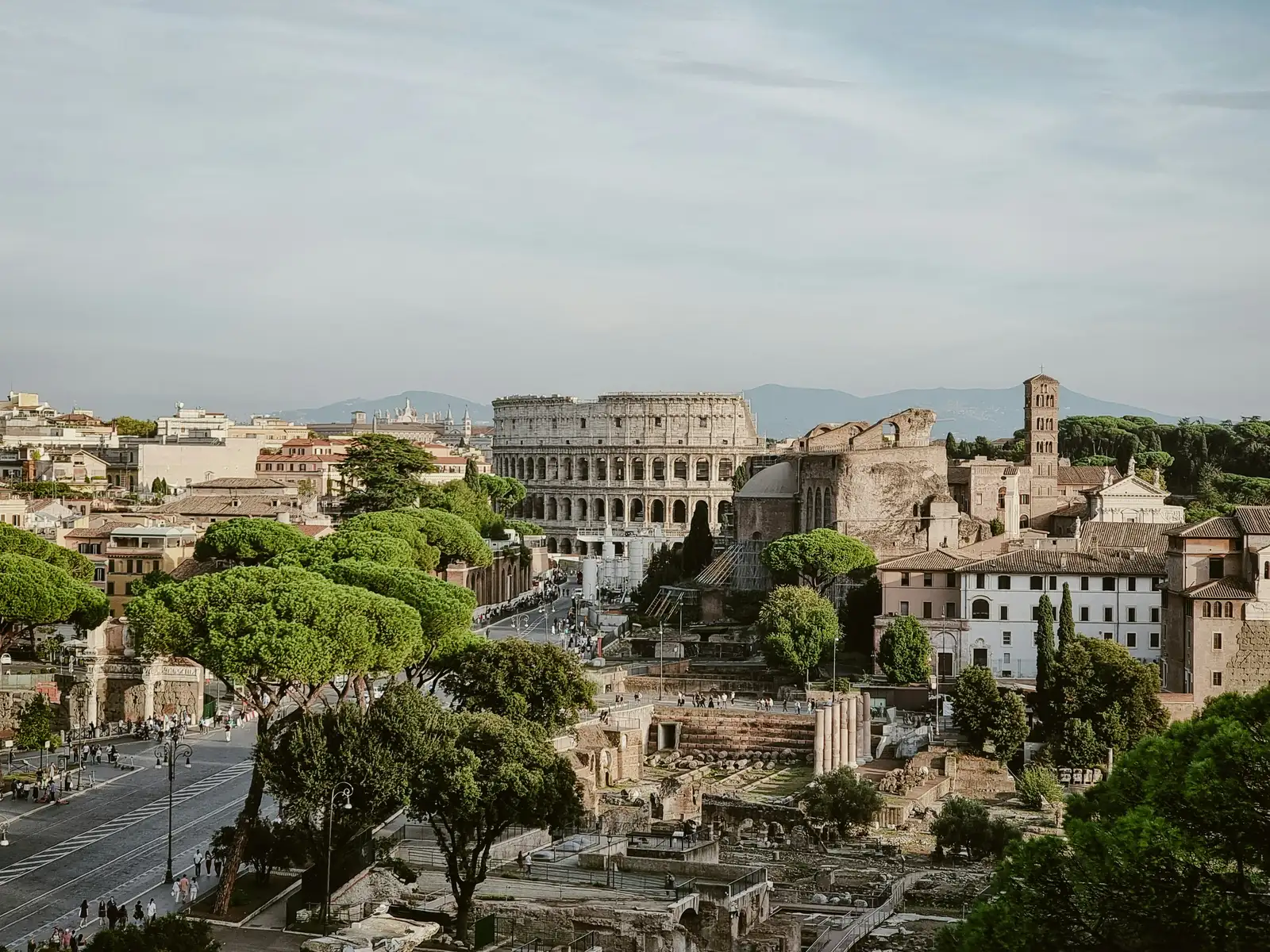

I stood in the Baths of Caracalla on a Tuesday morning with a group of fourteen partners from a London law firm, and the managing partner turned to me and said, "This makes our boardroom look like a broom closet." He wasn't wrong. The bath complex opened in 216 AD, held up to 1,600 bathers at once, and still has walls standing sixty feet tall two thousand years later. Nobody in that group remembered the slide deck from the day before. Everybody remembered standing under those walls.
That's what a Rome corporate retreat can do; it works better than most destination pitches you'll hear. Rome doesn't need you to manufacture significance. It has more of it than any conference center could ever simulate, and the trick isn't finding it. The trick is not burying it under the usual itinerary of coliseum photo, Vatican tour, farewell dinner, flight home.
Why Rome works for groups that don't want another generic offsite
Most cities sell you charm. Rome sells you proof. The Pantheon's dome, poured in 128 AD, is still the largest unreinforced concrete dome on earth, according to engineering surveys cited by the Smithsonian and repeated in nearly every architecture course taught since. Nobody in your executive team is going to out-argue two thousand years of structural engineering. That's a useful thing to put in front of people who spend their working lives arguing.
Rome has the bones for this too. Fiumicino airport runs direct flights from New York, Chicago, and most major European hubs, and the city center sits twenty minutes from Termini station on the high-speed rail line that connects to Florence, Milan, and Naples in under three hours. Land a sixty-person leadership group on Monday and you can have them in a working session by Monday afternoon. That matters more than planners admit, because the goal of any offsite is to get people present and thinking, not jet-lagged and resentful.
The Italian tourism board's meetings division tracks a steady climb in Rome's share of European corporate bookings over the past five years, driven by the same thing: old venues that actually work for meetings. The city has figured out how to rent out a sixteenth-century palazzo without pretending it's a hotel ballroom with frescoes.
Venues that aren't the Colosseum gift shop
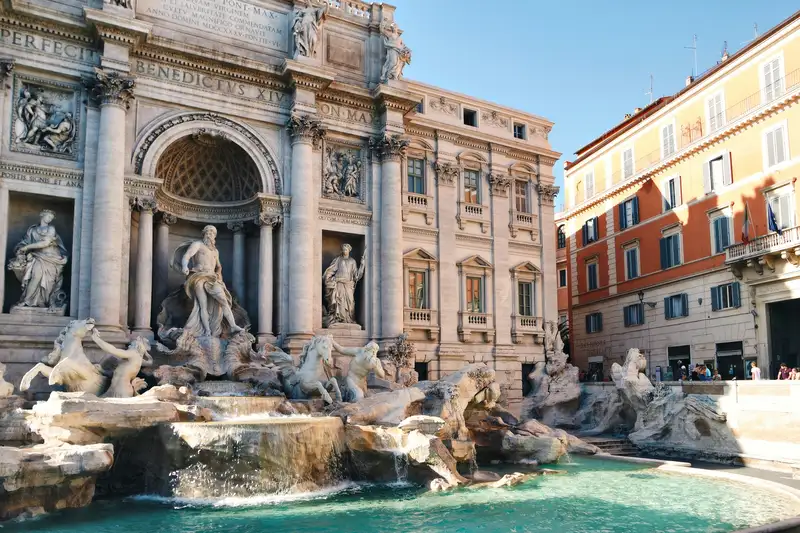
Every Rome retreat planner's first instinct is the big three: Colosseum, Vatican, Trevi Fountain. Skip two of them for your actual working sessions. Save them for the evening your group wanders on its own, gelato in hand, phones out. For the retreat itself, look at venues built for exactly this kind of gathering.
Palazzo Brancaccio, finished in 1886 and still owned by the same aristocratic family, rents its grand salons for private events and seats forty around a single table under ceiling frescoes nobody in your group has ever eaten lunch under before. It's a fifteen-minute walk from the Colosseum but feels like a different century entirely, which is the point.
For something with more room to move, the Auditorium Parco della Musica, Renzo Piano's three-building music complex finished in 2002, offers conference spaces that pair modern acoustics and full AV capability with architecture that's unapologetically contemporary. If your leadership team needs to believe innovation is possible in a city this old, put them in a Piano building for an afternoon. The contrast does the persuading for you.
Smaller groups do better outside the center entirely. Villas along the Appia Antica, the original Roman road laid down in 312 BC and still paved in places with its original basalt stones, offer the kind of privacy and control that a hotel conference room never will. If your group is under twenty people and the agenda calls for real candor rather than another panel discussion, a villa changes what people are willing to say out loud. The question of villa versus resort versus palazzo comes up on nearly every Rome planning call, and it's worth working through deliberately rather than defaulting to whatever the hotel sales team pitches first.
For a full comparison of how venue scale changes group dynamics, the analysis in Private Villa vs Resort: Choosing Intimate Venues for C-Suite Team Building lays out the tradeoffs between control and convenience better than most planners explain it on a first call.
Team building that doesn't feel like a scavenger hunt with a toga theme
Rome has a lazy version of team building and a good version, and the difference is mostly about depth. The lazy version rents togas and calls it gladiator school. The good version uses the city's own structure as the exercise.
Trastevere's market stalls and the Testaccio neighborhood's old slaughterhouse-turned-market, Mercato Testaccio, both run cooking classes built around small teams working a single dish from scratch, usually cacio e pepe or a Roman-style carbonara, under a local chef who has no patience for shortcuts and will say so. Splitting forty executives into teams of four, handing them a wood-fired stove and twenty minutes before the timer starts, tells you more about how people handle pressure than any trust fall ever has.
The Appian Way also works as a literal team-building device, not a metaphorical one. Walking groups of eight to ten along a two-mile stretch of the original road, past the catacombs of San Callisto, built starting in the 2nd century and eventually holding half a million burials across a network of tunnels, gives people forty-five minutes of unstructured conversation with colleagues they normally only see in meetings. No agenda. No facilitator with a clipboard. The long walk on stones that merchants and soldiers used on their way to Brindisi two thousand years before your company existed does something a conference room never will.
Neuroscientist Paul Zak has written about how trust-building works in shared physical experiences, arguing in a Harvard Business Review piece that novel, moderately challenging group activities trigger oxytocin in ways that accelerate team cohesion far faster than conventional icebreakers do. A two-mile walk on broken Roman paving qualifies as moderately challenging in a way a hotel conference room never will.
If your team-building planning process still defaults to escape rooms and trust falls, the broader argument for rethinking that default is laid out well in The Complete Guide to Team Building Activities, which makes the case that most standard exercises optimize for comfort rather than for anything that actually changes how a team behaves afterward.
Blending the ancient and the modern in the actual agenda
The mistake most planners make is treating history as decoration for the evenings and business as the daytime's only real content. Rome rewards the opposite approach. Build the history into the working sessions themselves.
A strategy session held at Palazzo Colonna, still occupied in part by the same family that's owned it since the 14th century, can open with a ten-minute walk through the Great Hall before anyone sits down. That's not filler. It's a framing device. A leadership team that walked through a painted ceiling commissioned to celebrate a 1571 naval victory before discussing 2027 priorities will see a different sense of scale. Decisions that felt urgent an hour ago look more like what they actually are: one entry in a much longer ledger.
The firms that do this well tend to structure the day in blocks: a morning session in a modern conference space with full AV and strong wifi, a midday break built around a specific cultural activity tied to the city rather than generic hotel catering, and an afternoon session back at the table with the morning's ideas pressure-tested against what the group experienced. The agenda design itself matters as much as the venue. A detailed breakdown of how to structure those day-by-day blocks for groups of twenty to fifty appears in How to Run an Effective Executive Offsite: Planning, Agenda and Travel Management, which covers the logistics layer most planners underestimate until they're standing in a palazzo lobby with no cell signal and a bus that hasn't arrived.
Getting a group of forty through Rome without losing anyone
Rome's center is walkable, which sounds like good news until you're trying to move a jet-lagged group of forty between a 9 a.m. session at Palazzo Brancaccio and an 11:30 lunch in Trastevere across cobblestones that were never designed for rolling luggage or, frankly, for comfortable walking of any kind. Factor in thirty extra minutes for every transition. Rome does not move at the speed your event app assumes it will.
Private coach transport solves most of this, but Rome's historic center has restricted traffic zones, called ZTL, that limit vehicle access during business hours in large parts of the downtown core. A planner who doesn't know this ahead of time ends up with a bus idling two kilometers from the venue while forty people walk the last stretch in dress shoes. Work with a ground operator who holds the permits and knows the current ZTL boundaries, which the city updates periodically and which aren't always reflected in older planning guides.
Hotel density around the center is high enough that lodging rarely becomes the bottleneck. The bottleneck is almost always the handoff between activities: the fifteen minutes nobody accounts for when a cooking class ends and a coach is supposed to be waiting outside a market that has no obvious street access for a sixteen-seat van. Build buffer time into every transition on the agenda, not the ones that look risky on paper.
What to actually bring home
The test of a Rome retreat isn't whether people enjoyed themselves. Almost everyone enjoys a week in Rome. The test is whether anything about how the team operates changes once they're back at their desks in Chicago or Frankfurt or wherever the actual work happens.
That means building the retreat around specific decisions, not general inspiration. If the point of the trip is to align a leadership team on a three-year strategy, the Rome setting should support named owners and dated commitments coming out of the sessions, not a shared memory of a good dinner at Trattoria da Felice on Via Mastro Giorgio. The argument for tying offsite design to decisions rather than themes is made in detail in Leadership Alignment Workshops: Team Building Agendas That Drive 2027 Strategy, and it applies to a week in Rome as it does to any other location.
Measuring whether any of it worked afterward is its own discipline, and most companies skip it, defaulting to a satisfaction survey and a photo gallery that tells leadership nothing about whether behavior actually shifted. If Rome is the setting, the follow-up should match the ambition of the setting. Build in a thirty, sixty, and ninety-day check against the specific commitments made during the sessions, not a vague retrospective on how the trip felt.
On my last afternoon with that London law firm group, the managing partner who'd made the broom closet joke stopped me outside the baths and asked whether I thought the Romans knew, while they were building, that the thing would still be standing two millennia later. I didn't have a good answer. Neither did he. But he'd stopped checking his phone for the first time in three days, and that, more than anything on the agenda, was the whole point of bringing him there.



Comments (0)
No comments yet. Be the first!