
Andalusia doesn't need a hard sell. The region sells itself, white villages spilling down hillsides, the smell of orange blossom in Seville's old quarter in April, flamenco that you hear before you see. The real question for a corporate retreat planner isn't whether Andalusia is appealing. It's whether the venues can actually support a working group of 30 or 150 people without collapsing into logistical chaos.
The answer, for the right properties, is yes. But the shortlist is shorter than the region's tourism profile suggests. A lot of beautiful haciendas outside Seville have one breakout room and a catering team that tops out at 40 covers. A lot of Malaga beach resorts have the conference infrastructure but none of the character that justifies flying a team to southern Spain. The venues worth booking sit at the intersection of those two things, and this article is about those.
Getting Your Group There: Trains, Transfers, and the Madrid Connection
Before venues, logistics. Most international corporate groups arrive into Madrid Barajas or Malaga Costa del Sol Airport. From Madrid, the AVE high-speed train to Seville runs the route in roughly 2.5 hours, with departures from Puerta de Atocha every hour or so during peak times. A business-class car on the AVE is genuinely pleasant, quiet, spacious, views of the Castilian plateau giving way to olive groves around Córdoba. For groups of 20 to 40, booking out a full car section is possible with advance coordination through Renfe's group desk.
Malaga is easier for groups flying in from northern Europe or the US East Coast, with direct routes from London, Amsterdam, and New York. Malaga to Seville is just over two hours by car, or there's an AVE connection via Córdoba. Granada sits roughly 1.5 hours from Malaga by road, no high-speed rail yet, though the Antequera-Granada line has been in intermittent development for years.
For groups above 50, private coach transfers are almost always worth the cost. Shared shuttle services introduce the kind of low-grade coordination stress that colors the first few hours of a retreat poorly. Budget roughly €400–€700 for a full-size coach transfer from Malaga Airport to Seville, depending on the operator and season.
Haciendas Outside Seville: The Category That Delivers
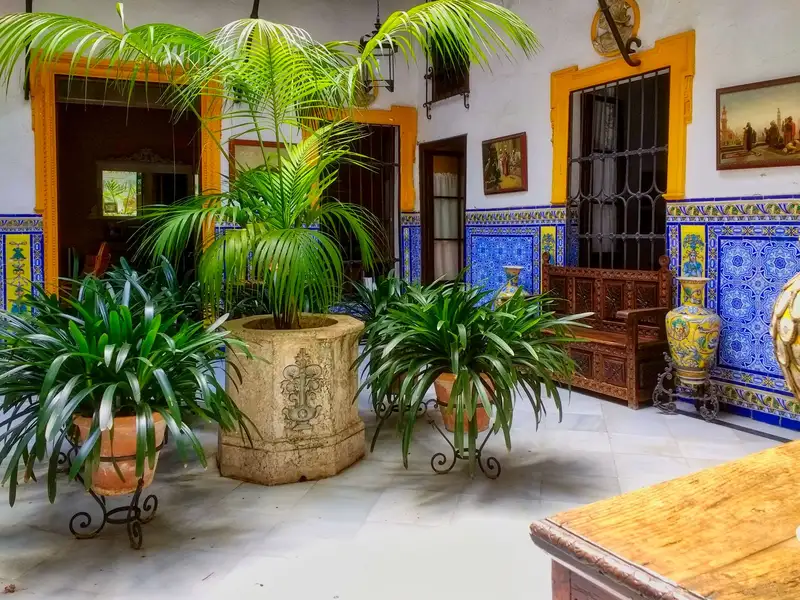
The working hacienda-as-retreat-venue is a genuinely Andalusian format, and Seville's countryside has some of the best examples in Spain. These are working agricultural estates, typically olive or citrus farms, that have been converted, partially or fully, into hospitality venues. The bones are usually 17th or 18th century. The meeting rooms are often carved out of former stables or granaries, which sounds charming and is, but also tends to mean natural light is limited and the AV setup requires careful advance planning.
Hacienda de San Rafael, between Seville and Jerez near the village of Las Cabezas de San Juan, is one of the most consistently well-run venues in this category. It accommodates up to 30 guests in its rooms and cottages, which makes it a natural fit for senior leadership offsites or executive team retreats of 20–30 people. The main terrace seats 50 for dinner. The property runs its own olive grove, and the kitchen sources from local producers in a way that feels genuine rather than performative, the gazpacho here is made from tomatoes grown on-site, and you notice the difference. AV is available for the main sala but needs to be confirmed with the events team well in advance, as the property's primary identity is as a luxury hotel rather than a conference venue.
For larger groups, Hacienda Benazuza near the town of Sanlúcar la Mayor, about 20 minutes west of Seville, operates at a different scale. The property has hosted groups up to 200 for outdoor events and has dedicated conference facilities with full AV, including projection systems, lapel microphones, and simultaneous translation booths for international groups. The main salon accommodates 80 in theater configuration, 50 in boardroom. The outdoor spaces, organized around a traditional Andalusian courtyard with a central pool, are where the venue genuinely earns its rate, evening dinners under the courtyard arcades, with a flamenco performance that doesn't feel like a tourist package, are a recurring highlight for groups.
Paradores: The State-Owned Option That Planners Underuse
Spain's Parador network is a national hospitality system built around converting historic monuments, castles, convents, palaces, into hotels. The quality varies, but the Andalusian Paradores are among the best in the network, and corporate planners consistently underuse them.
Parador de Granada occupies a former convent inside the Alhambra complex, on the hill above the city. This is not a metaphor or a tourism brochure line, you are inside the Alhambra grounds, 50 meters from the Nasrid Palaces, in a building that dates to the 15th century. For groups of 20–40, private dinners in the convent cloister are bookable. The conference facilities are modest, one main meeting room with standard AV, capacity around 40 in theater, but for a senior leadership retreat where the setting is doing significant work, modest facilities are often enough.
The Parador rate structure is government-regulated, which means pricing is more transparent and predictable than comparable private luxury hotels. Group rates for 20+ rooms typically come with meeting room access included, though catering packages are priced separately. Expect to pay €180–€260 per room per night depending on season, with high season (April–June and September–October) at the upper end.
Parador de Málaga Gibralfaro sits on the hill above the city with direct views of the bullring, the port, and on clear days, the Rif Mountains of Morocco across the strait. The property is smaller, 38 rooms, which limits it to groups of 30 or fewer for full buyout. What it offers that most conference hotels don't is a setting that produces genuine conversation. Groups that stay here report that the evening terrace dinners, with that view and a local wine list anchored by wines from the Málaga DO, are among the most productive informal sessions of their retreats. Sometimes the venue is the programming.
Malaga Resorts: Conference Infrastructure at Scale
For groups above 60 that need serious conference infrastructure, the Malaga coast, specifically the stretch between Marbella and Estepona known as the Costa del Sol, has the inventory. This is not the most characterful part of Andalusia, and anyone pretending otherwise is selling you something. But if you need 1,500 square meters of breakout space, a general session room for 150, and reliable high-speed fiber throughout, the resort hotels here can deliver.
Finca Cortesín near Casares, about 90 minutes west of Malaga Airport, operates at a different level than most Costa del Sol properties. It's a genuine five-star estate hotel with 67 suites, a conference center that handles up to 180 in theater configuration, and outdoor event spaces across 200 hectares of gardens and golf course. The AV setup is full-service with in-house technicians, which matters more than most planners acknowledge until something goes wrong at 8:45am on day one. The food program draws heavily on Andalusian ingredients, local tuna from Barbate, Ibérico pork from nearby farms, olive oil from the property's own trees. For groups that need scale without sacrificing quality, this is the strongest option on the Costa del Sol.
Hotel Marbella Club, on the Golden Mile between Marbella town and Puerto Banús, is older and more storied, it opened in 1954, founded by Prince Alfonso of Hohenlohe. The conference facilities are competent rather than exceptional, handling groups up to 120 in its main ballroom. The real value here is the property's general infrastructure: multiple restaurants, a beach club, spa, and enough space that a group of 80 doesn't feel like it's taking over. For retreats where social cohesion across a larger group is the primary objective, the variety of informal gathering spaces matters.
Wellness Integration: What Actually Works
Andalusia has two wellness traditions that translate well to executive groups, and several that don't.
The hammam tradition is genuine. Arab bath culture came to Andalusia with the Moorish occupation and never fully left. Hammam Al Ándalus operates bathhouses in Granada, Seville, Cordoba, and Malaga, and their group booking infrastructure is solid. A two-hour hammam session for an executive group of 12–16, hot pools, cold plunge, steam room, optional massage, runs roughly €60–€90 per person depending on the package. As a mid-retreat reset after two days of sessions, it works. The heat, the silence, the enforced disconnection from phones: it produces the kind of physical decompression that a wine tasting or team dinner doesn't.
Horseback riding through the olive groves is the other option worth considering, and it's more available than most planners expect. The Andalusian horse, the Pura Raza Española, is bred in this region, and there are working equestrian centers near Jerez, Ronda, and the Doñana marshlands that run corporate group sessions. These aren't trail rides in a line. A well-run session at a center like Yeguada La Cartuja near Jerez, which breeds directly from the Royal Andalusian School of Equestrian Art lineage, includes a handling demonstration and guided ride across the estate. For executives who've never been on a horse, the mild discomfort of trying something genuinely unfamiliar together is, oddly, one of the better team dynamics exercises available.
What doesn't work: cooking classes scaled above 20 people, group flamenco lessons (they're almost always awkward in ways that don't generate good conversation), and winery tours that are really just extended sales pitches with better scenery.
Sustainability Credentials: What to Ask For
Andalusia's retreat venues increasingly carry sustainability certifications, though the standards vary enough that it's worth knowing what you're looking at. The most meaningful certification for Spanish hospitality properties is the Q de Calidad Turística with its sustainability module, administered by the Instituto para la Calidad Turística Española. Biosphere Tourism certification, developed by the Responsible Tourism Institute in partnership with UNESCO, is the other credible mark.
Several hacienda properties have pursued certification specifically because their agricultural operations, olive cultivation, citrus groves, are already managed under organic or low-impact standards. Hacienda Benazuza, for instance, has implemented greywater recycling and sources kitchen produce from within a 50-kilometer radius for the majority of its menu. These aren't marketing claims; they're operational practices that can be verified by asking for the certification documentation before you sign a contract.
For groups that include sustainability in their retreat objectives or need to report carbon impact to their boards, it's worth requesting a detailed supplier breakdown from any venue. The good ones have it. The ones that don't will tell you a lot about their actual commitment.
Matching Venue Type to Group Size and Objective
A rough framework, because planners ask for one:
Groups of 20–35 with a senior leadership or strategic focus: hacienda buyout or Parador. The intimacy of the setting does work that no breakout agenda can replicate. Budget €300–€450 per person per night all-in.
Groups of 35–80 with a mixed agenda (formal sessions plus social programming): Finca Cortesín or a well-chosen hacienda with outdoor event capacity. You need the infrastructure for formal sessions and the setting for informal ones. Budget €250–€400 per person per night.
Groups of 80–200 with conference-first requirements: Costa del Sol resort properties, with Finca Cortesín at the quality ceiling and several competent options below it. Budget €180–€300 per person per night, with AV and catering negotiated separately.
The one mistake that cuts across all three tiers: booking a venue primarily for its visual appeal without confirming the AV and catering operations in detail. Andalusia has no shortage of beautiful properties that will disappoint a group of 60 when the projector cable doesn't match anyone's laptop and dinner arrives 45 minutes late. Venue visits, or at minimum, detailed reference calls with recent corporate clients, are not optional.
The Day After: Planning the Return
The retreat ends when the coaches leave for Malaga Airport. The work doesn't.
Andalusia is good at producing the emotional conditions for commitment, the setting, the food, the unhurried pace of an evening in a hacienda courtyard. What it can't do is translate those conditions into changed behavior when the team lands back in London or New York or wherever they came from. That requires a structured first-week-back plan: specific commitments, named owners, a 30-day check-in already on the calendar before departure.
For more on this, see Partners.
Groups that build this into the final session of the retreat, 45 minutes, concrete outputs, no inspirational speeches, retain more of what they produced than groups that close with a group dinner and a toast. The dinner is still worth having. Just do the 45 minutes first.

Comments (0)
No comments yet. Be the first!